
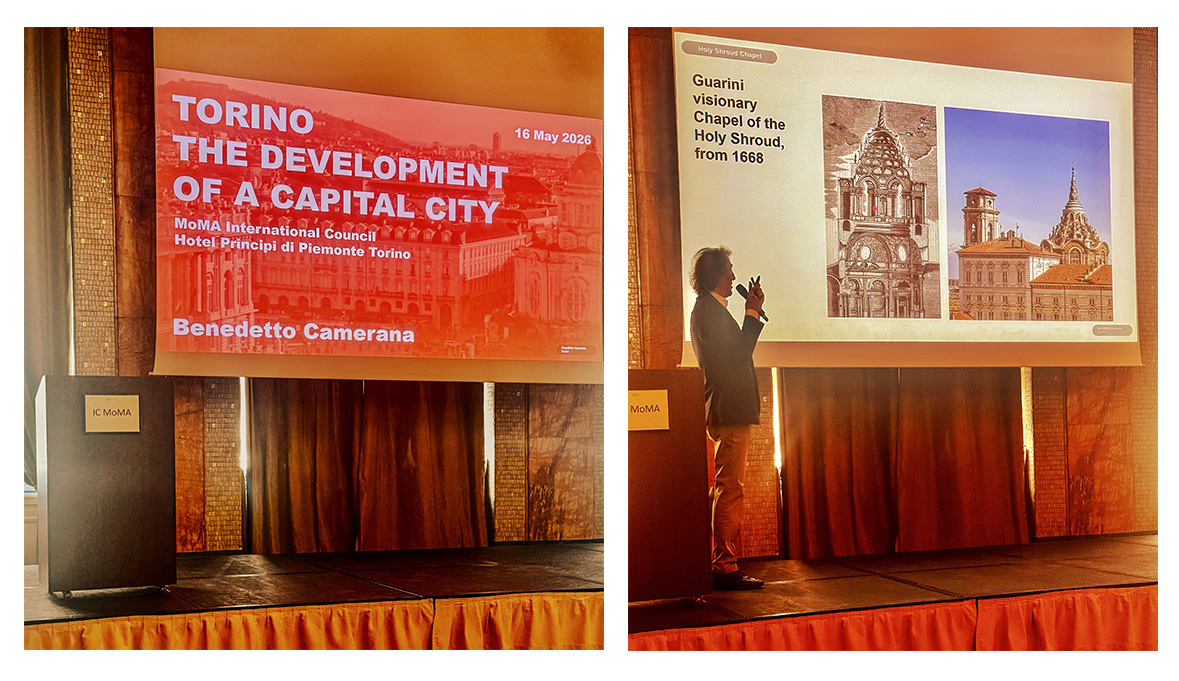
A CITY ALWAYS DESIGNED: TURIN ACCORDING TO BENEDETTO CAMERANA
Turin wasn’t born a capital: it became one through the culture of design. This is the idea at the heart of the lecture Benedetto Camerana gave for the MoMA International Council, hosted in Turin in May. He elaborated on the city as a cultural and political construct, capable of transforming and evolving over the centuries with creative and innovative solutions in the face of every crisis or need. The lecture traces the city’s urban history as a long sequence of transformations driven by technological, architectural, and artistic innovations, which have acted as instruments of political vision and soft power. From the move of the Savoy capital from Chambéry to Turin in 1563 under the House of Savoy (not only the first great visionaries, eleven generations of the Savoy dynasty, were the initiators and actors of the transformation), to the contemporary city, Turin is described as a “capital built by design“. Camerana’s narrative retraces the crucial moments in the city’s history through the lens of design. From the Roman city and its grid-like layout to the Baroque expansions, to the Turin of Guarino Guarini, where geometry and spirituality redefine architectural space. And then Filippo Juvarra, who transformed residences, urban axes, and the landscape into a coherent system of dynastic representation, all the way to Alessandro Antonelli and the structural challenge of the Mole Antonelliana (also reinterpreted by Mario Merz’s light installations). It’s no coincidence that the city’s symbol challenges the laws of architecture.
Camerana also highlights how Turin has built its role as a European cultural capital through specific museum projects, theaters, collections, and educational institutions. From the Galleria Sabauda to the Egyptian Museum, from the Teatro Regio redesigned by Carlo Mollino to the University and the Polytechnic, created at different times to support technical, scientific, and industrial development. Alongside the cultural dimension, the industrial and technological one emerges: obviously, Fiat and the automobile industry. The fabric supported by this avant-garde then gave rise to the aeronautical industry, and today the aerospace sector, comprised of leading companies such as Leonardo, Thales Alenia Space, and ALTEC, which contribute to making Turin one of the leading European hubs of the space economy (a significant portion of the Artemis II mission components originated in Turin’s industrial fabric). Another theme of the lecture is the transformation of industrial production sites into cultural venues. From the Lingotto—now home to the Pinacoteca Agnelli and the Pista 500—to the OGR, Turin has successfully reinterpreted its industrial symbols, giving them new civic and cultural functions.
The final section of the city tour identified by Camerana is dedicated to the contemporary city: from the Castello di Rivoli to the GAM, from the OGR to the MAUTO, up to projects such as the Luigi Einaudi Campus and Environment Park. What emerges is the image of a city that continues to use design as a tool for civil, cultural, and technological evolution. “The development of a capital city” is one possible definition of Turin’s identity: a city that has built its role through the design of space, institutions, and relationships between culture, innovation, and the territory.