
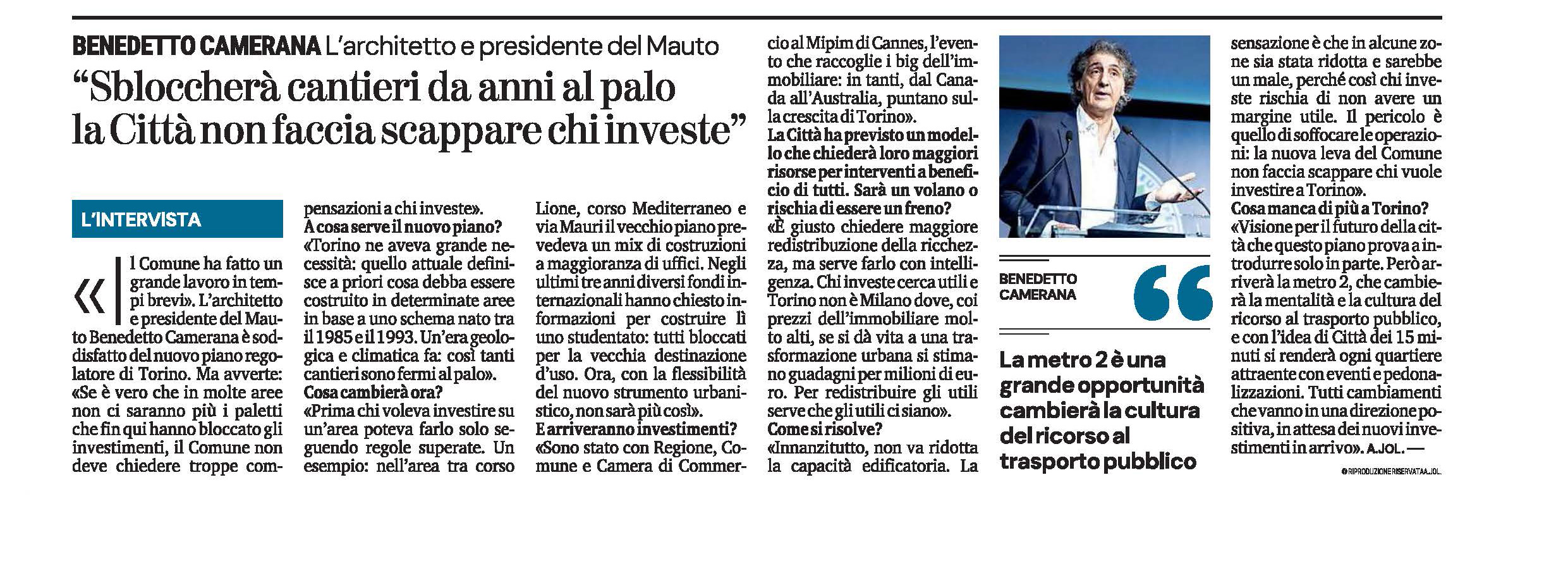
INTERVIEW – TURIN’S NEW MASTER PLAN: THE INVESTMENT CHALLENGE
New opportunities—and the risk of missing them—are also the focus of an interview published in the Turin pages of La Stampa on March 18, as part of an in-depth analysis by Andrea Joly on Turin’s new Master Plan. Camerana sees it as a good plan: greener, oriented toward widespread development, attentive to public land and the balance between built environment and spaces returned to the city, and embracing the concept of a “15-minute city,” with 34 new neighborhoods identified and designed as autonomous hubs, equipped with essential services.
A necessary update, considering that the previous plan dated back to 1995 and envisioned predetermined development based on needs defined between 1983 and 1995—”a geological and climatic era ago,” observes Camerana. Following the 2008-2010 financial crisis, the plan ultimately slowed urban growth, slowing or halting investment in many areas of Turin. But alongside the positive assessment, a critical issue emerges: the relationship with investors. At MIPIM, Camerana explains, international interest in Turin is tangible and transversal, from Canada to Australia. To truly capture it, however (and encourage investors), the city must be able to embrace development proposals without excessively tightening conditions. It must allow opportunities to grow to create margins and generate profits, especially in Turin’s real estate market, which lacks the dynamism and financial returns of Milan’s. Ultimately, only development can provide the opportunity to achieve a redistribution of wealth, so it must be fostered with judgment and intelligence. When asked what Turin lacks, the answer is straightforward: an even stronger and more shared vision, reviving Turin’s great tradition of the Strategic Plan, central to the growth strategy of governments from Castellani to Fassino. Projects like Metro 2 and the 15-Minute City are steps in the right direction, respectively changing the mentality and culture of public transportation, the approach to the city, and making each neighborhood attractive with events and pedestrian zones. What is needed, perhaps, is the ability to promote endogenous real estate investment and know how to guide it: attract it, direct it, and put it to work to build shared value.