
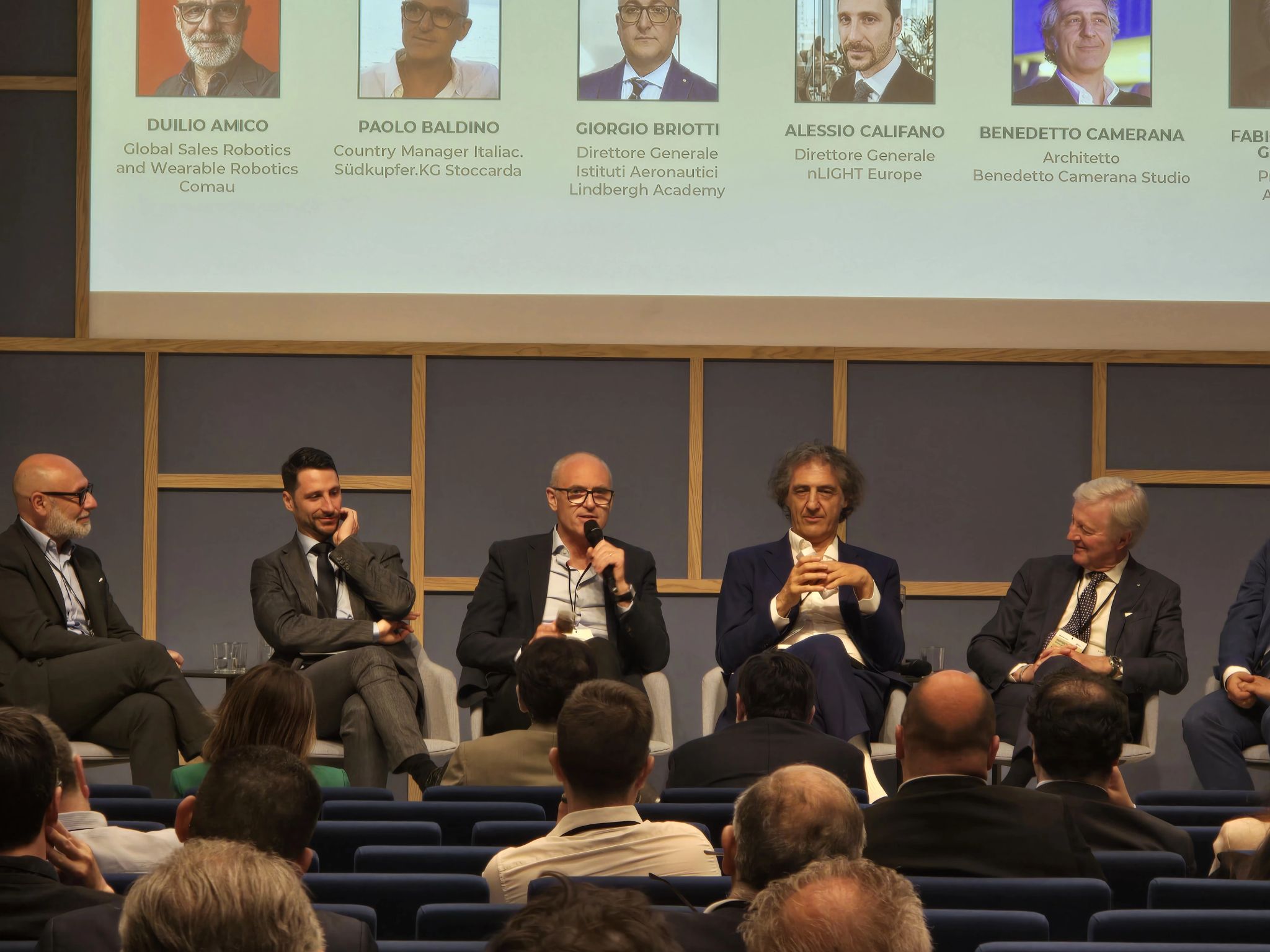
CROSS-BORDER LESSONS: BENEDETTO CAMERANA AT IMPRESE SENZA FRONTIERE
The trade relationship between Italy and the United States is consolidated, profitable, and overall stable. During “Imprese senza frontiere” Benedetto Camerana shared four personal experiences that exemplify integration with the United States from the perspective of architectural design.
The first is Turin’s Environment Park: the large, pioneering technology and innovation district, the first example of green architecture in Europe, which Benedetto Camerana created when he was just over 30, between 1997 and 1999, after extensively studying it at university. Green architecture is a cultural movement born in the US, particularly in New York culture, with the research of James Wines with S.I.T.E. for the BEST Department Stores and then, above all, with Emilio Ambasz, the great Argentine architect and designer, Director of Architecture and Design at the MoMA in New York. Camerana was the first to import this organic approach between landscape and construction to Italy, first as a researcher, as editor of the magazine EDEN. Architecture in the Landscape, and then, professionally, by inviting Ambasz himself to collaborate with him and win the competition for Turin’s Environment Park. The project anticipates the debate on the green economy by years.
The second moves to Los Angeles, to the Petersen Automotive Museum, where Camerana worked as a design consultant for exhibit design, contributing to the definition of the exhibition modalities of one of the most important American centers of automotive culture.
The story continues by looking to the broadest horizon of all—the sky—with two cosmic projects. The first is the Grottaglie Spaceport in Puglia: an infrastructure for tourist and commercial suborbital flights, which Benedetto Camerana is designing, and which we discussed some time ago. The flight operator will be Virgin Galactic, an American company that already offers suborbital space flights and will make the Grottaglie spaceport a sort of European twin of the Gate of America spaceport in New Mexico.
Finally Turin, today at the center of an industrial and scientific system linked to space exploration. Benedetto Camerana is involved in the development of the Space Center—the future Aerospace Center—an exhibition and scientific dissemination project dedicated to Turin’s fundamental contribution to international space programs. This industrial and research ecosystem includes entities such as ALTEC, a company owned by Thales Alenia Space, one of Europe’s leading space companies, and the Italian Space Agency (ASI), as well as Leonardo, a leading company in space propulsion. It works closely with NASA, participating in missions such as ExoMars and Artemis and in the construction of modules for the International Space Station. The Space Center was thus conceived as an exhibition and narrative platform: a space capable of reflecting the city’s role in a global system, showcasing the projects developed in Turin for space exploration. So yes, when a few weeks ago, all of humanity was moved by the photos of the planets in the system taken during the Artemis mission, the credit also goes in part to our city’s industrial fabric and expertise.